Projects
Torch Songs for the Ezo wolf and Toolache Wallaby
Torch songs for the extinct Ezo or Sakhalin Wolf (Hokkaido, Japan) and Toolache Wallaby (SE Australia). While in residence at Tenjinyama Art Studio I chose animals from my home area as well Hokkaido, who had suffered.
Torch songs are sentimental vocal jazz songs, a yearning for someone or something lost. All over Japan, but particularly in Sapporo’s tiny coffee shops, lunch spots and food chains, torch songs and ballads are the soundtrack that formed a wistful merry-go-round in my brain.
The Ezo wolf was sacred to Ainu people and was worshipped as the deity Horkew Kamuy (“howling god”) while the Japanese people also revered it. Wurundjeri groups in Australia gave an ancestral spirit animal to each child born, who then protected that animal. I have chosen parallel animals of absence. The Enzo wolf and the Toolache wallaby quickly became extinct, under different circumstances, upon contact with settler-colonial agricultural and hunting practices.
Work at Hub Feenix, Meltola, Finland
Musical exploration of Hub Feenix basement – a former TB sanitarium and hospital
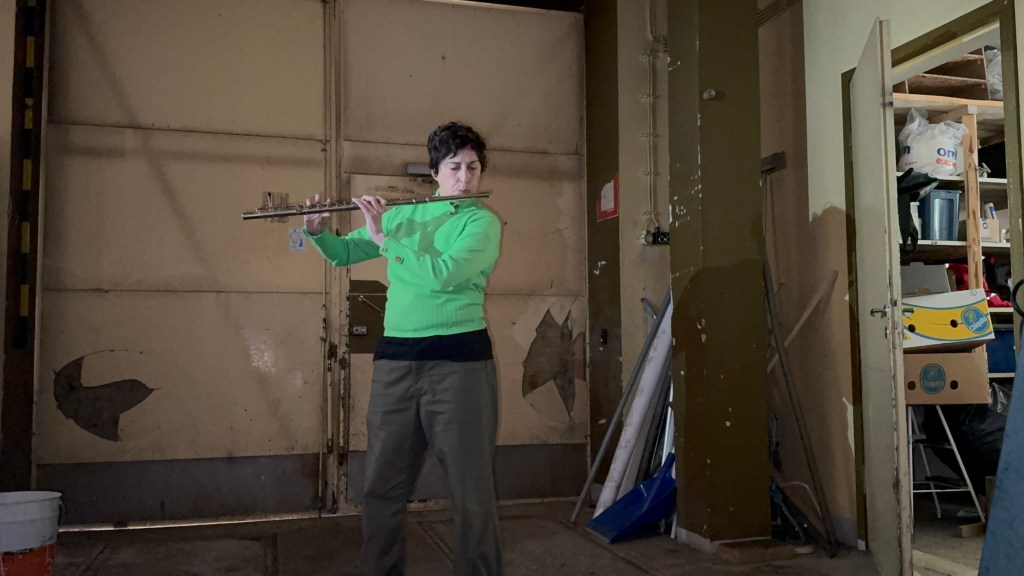
While I explored locations around Hub Feenix, I played with the idea of proximity and distance, technical elements found in reverb. I was interested in how closeness can imply a range of colours from claustrophobia and confinement to intimacy, kinship, love, family and solidarity. Similarly, distance can invoke aloneness, separation, to silence/the unknown, to dreaming and space.
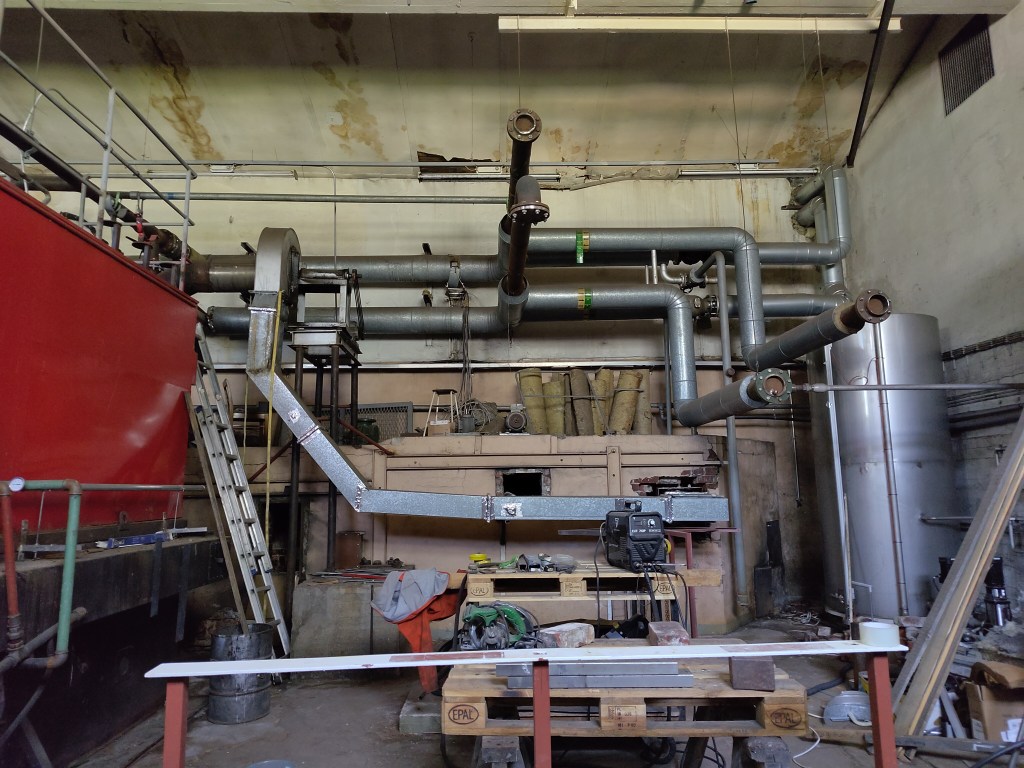
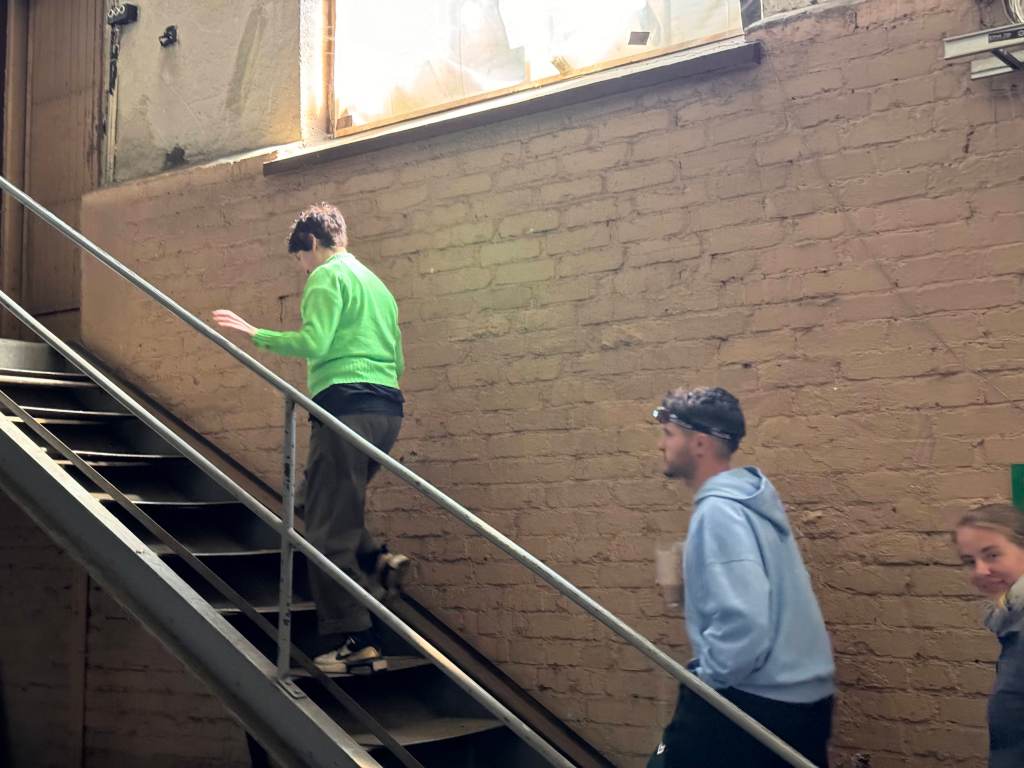
Collaborations in the basement corridor and a two-story silo
Performance for flute and synth: Mel Chilianis and Clint Sleeper
Performance for flute and percussion: Mel Chilianis and Clint Sleeper
Symbi-chime for Climate Constellations
For a 2023 exhibition I performed on recently flooded Wurundjeri-Woiwurrung land to the sounds and sights of redevelopment. The video, deliberately out of sync with the audio, a surface glitch that asks us to consider the supply chains behind everyday technologies.
Symbi-chime recognises recording ‘nature’ with technological devices is not straightforward in this moment. While we will always need a judicious use of technology, this project invites us to acknowledge the usually-unseen person behind our recording devices. Raven Chacon has pointed out there is a large degree of “listening extraction” tied up with a colonial gaze (Navajo installation artist and composer). As we seek to capture and display our environmental sonic work, this bears remembering.
Here I juxtapose my improvised performance in Pipemakers park, Wurunjeri Woiwurung land, which oscillates between a harmonious exchange and discord.
I am joined by magpies (polyphony) and the flute’s reverberation is produced by the pipe in a particular place, rather than an electric modelling of space.
Video: Beatka Provis, April 2023
Yūgen
Yūgen was an audiovisual project between myself and Cat Lew that explores the exteriors of Brimbank interleaved with somatic experience. The sound and the visuals play with gaps and waiting, while the footage threads through Sunshine’s industrial areas and produce shops.
The exhibition was projected onto windows at night between July 21 until September 4, 2023.
Video description: One: Three-dimensional brain-scans on black, white, pink, green and aqua backgrounds slowly spin. Two: Tunnels in a parkland, shot in black and white. Concrete pipes vertical and horizontal, alternate with trees and scrub, and an old brick building. A tiny shed closes. Three: In colour, we see local buildings from inside a train, then outside, around the suburb, Sunshine. Four: A colourful outline of a brain’s folds, appears like an exploratory track on a black background. Multiples of the brain in a transparent human head appear, before the brain and wavy lines fill the screen again.
Sista Creatives Rising – composition
I was excited to work with Sista Creatives Rising to provide composition and sound design for two documentaries.
Sista Creatives Rising is a project founded by Black, invisibly disabled mother-daughter duo, Claire Jones and Amaranthia Sepia. Together, they develop disability-accessible events, focused on marginalised women and marginalised genders, called Art & Mind.
As part of their work for Sista Creatives Rising, they advocate for virtual and hybrid spaces for disabled, chronically ill/immunocompromised people, along with people who aren’t disabled but want to stay safe. With mask mandates fading, especially in healthcare, many people are restricted to their homes. Since Black people are disproportionately affected by COVID, they are looking for Black people to share their stories. Learn more!
‘Audio Test’ by Quinn West, with MC
Through the SDA residency (see below), I had the opportunity to work with Quinn West, a Deaf media artist on their Objects of Access project. Quinn’s access object, something that brings them ease, is a hearing device like a cochlear implant. But they also pointed out that this is not necessarily easeful, and can distort and be really difficult in some situations. The access object can therefore be more nuanced.
To explore this, Quinn had some ideas, and wanted to collaborate with a hearing person, who’s also a sound artist (me). As inspiration, they told me about a film program Hearing Aids which frames spacial sound not always rooted in the ear and an installation, Hearing Aid by Michael Snow. Snow’s installation draws attention to distortion through recording a sonic object in space, which is then played back and recorded again in a different position in space. This process is repeated and asks the listener to consider how sound recorded (represented) distorts in.
My initial inspirations were a sound installation by Carsten Nicolai that used ultra low sub-frequencies to distort lights in a rotating basin of water. And more of a musical performance by Camille Norment that used distortion and feedback and played with nostalgia.
I first thought about distortion as a musician, as a changed audio signal in a musical or production context. In audio production, distortion can be either intentional like a fuzzy punk guitar sound or undesired sonic destruction like clipping. It’s most frequently associated with increased gain and feedback. After chats with Quinn, I began to see how distortion depended on a spatial context for them. Quinn says, “essentially, I hear my life through a microphone.”
Quinn recorded themself saying audio test words, words that are given to D/deaf people during hearing tests, in three different environements: a closet, in a car, and a busy street. They used the microphone in their hearing device to record these, and passed the audio files on to me. We talked more, and decided to add several dimensions: I would add bass and low frequencies in the same rhythms as the words and phrases as Quinn is able to feel the vibrations of the bass. Quinn would work on animated text that distorted in the same ways.
I recorded the rhythm live to Quinn’s words as I was listening, and also looked at the waveform as a visual cue. I liked how the noisier spaces [city street] made it difficult for me to hear the words and rhythm. This made me think really differently. I was straining to hear through the distorted signal, and the meaning was often lost. This made me aware of my hearing privilege, an interesting thing to be reminded of when using audio software.
Excerpt from: City street
Socially Distant Art: SDA
I’ve participated in a year-long residency program with many amazing artists, who are mostly based in North America. The program focuses on an intersectional approach to accessibility, mutual aid and disability justice.
Currently we are working on Objects of Access as a living, breathing archive. The project features different artists and the objects they use to cope, thrive, and find joy in their lives, while inviting reflection on accessibility as an aesthetic and continual process. Artists explore the objects that bring them comfort, inspiration, and support, such as a musical instrument, a cane, glasses or a trusty bullet journal.
Residency time period: July 2022 – August 2023
Circle Messages
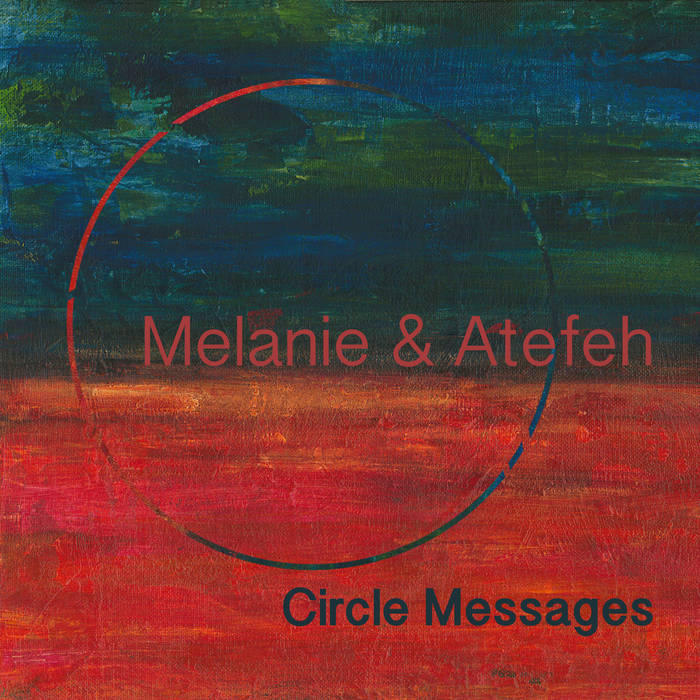
Collaborative composition with Iranian composer and brilliant santour player Atefeh Einali (now based in the UK and who uses collaboration as a distinct part of her composition process. (Check out her websiste!). We created Circle Messages in 2018 sending each other sound files and video messages over Telegram.
From Atefeh: We want to make a journey for our audiences step by step from the first piece to feel kindness, love, humanism, fear, sometimes anger, sadness, and all of our emotions, as we felt when we were composing these pieces. In our music, you see the merging of east and west. The Iranian part shows the new concept in making intervals, for example in Segah Dastgah we focus on one note that has an unusual tune in Iranian music (this is a quarter note). Also, in Chahargah Dastgah we have “Mojanab intervals” (135-145 cents), this is the third interval that is made with a quarter note. So, we want to merge these new intervals with the tonal ones in western music and arrange them with electronic processes, with noises, breathing sound, and singing that show our feelings in an innovative atmosphere. Finally, we want our words as music to connect with people around the world because music is a language that everybody understands.
From Melanie: For many months we sent messages to each other. Many with audio, even more in the Telegram app’s face ‘circle’. The first message that Atefeh sent was the video of the santoor with an explanation about tuning and the way it can be struck with different hammers. And then she played it and I was amazed and drawn in by its timbre and harmonies.
Circle Messages came together out of a need to hear our melodies, and to pair distinct harmonies with time-travelled noisy electrotextures. Often playful, with sections that occasionally jar, our sounds went from Tehran to Melbourne; from Melbourne to Tehran, to give form to our compositions. Sometimes this geographical space is audible in the music as surface noise, or in mixing and panning choices. In our messages to each other, we gave feedback about music, shared thoughts and feelings, frustrations, and joy. When I was remixing the final piece, Rast-panjgah, there were protests in Iran and the Iranian government had shut down Telegram, an application that the population relies on to message each other. I mixed the rest of Rast-panjgah with a keen sense of Atefeh’s absence, and concern for Iran.
Released: July 18, 2018
Inside Voice – graphic painting
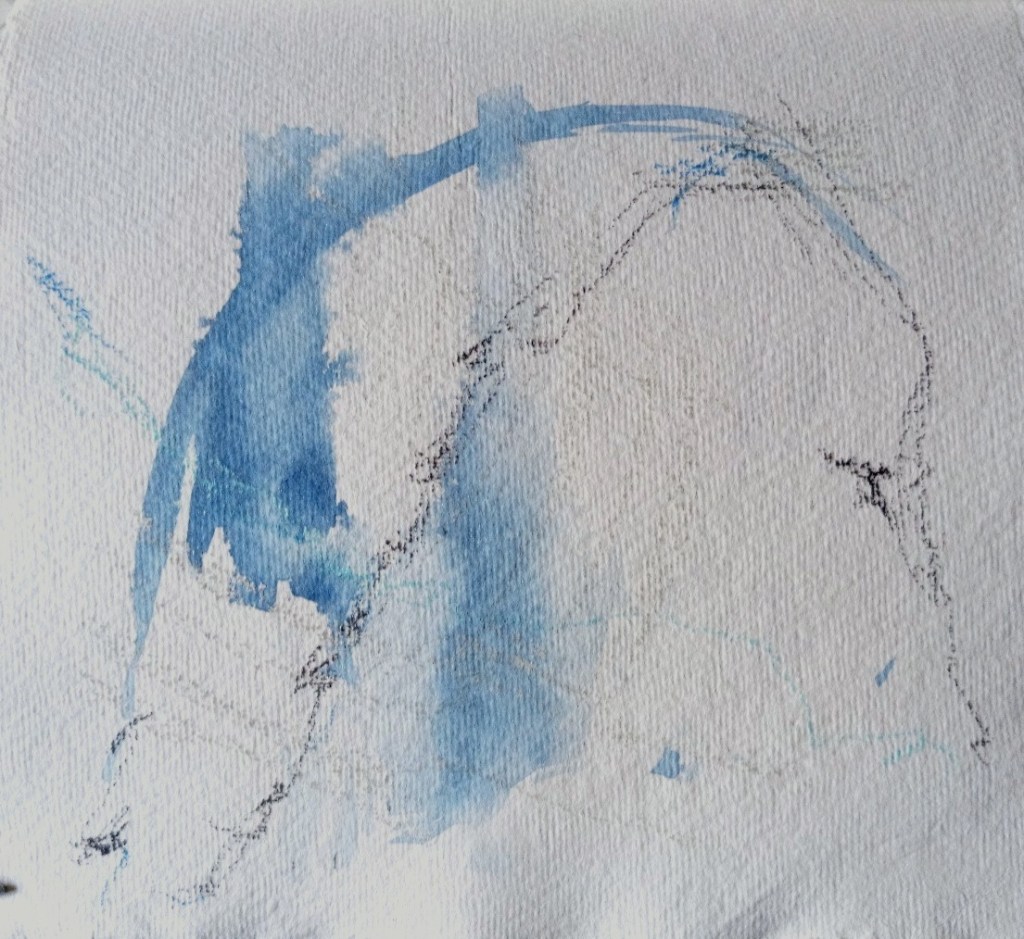
Rangga Purnami Aji —composer, live coder, and video artist—living in Yogyakarta, Indonesia interpreted this graphic score for three soundscapes and electric guitar.
 Mel Chilianis